Thursday, October 15, 2015

MYST #3: "Neighbors" or "What Happened to Belushi?"

When you think of John Belushi, you get that image of COLLEGE in your head, some weirdo, community college kid, and some great SNL nostalgia. Always the crazed imbecile with some great one-liners (mention some). And Dan Aykroyd? He's the father-figure, always the voice of reason. Yet in Neighbors, this quota is completely flipped, and it'll totally throw you a fast one.


My dad raves about this movie, how it's Belushi's last film and how that says something. As the uninformed slup of a person I am, there was no recognition for me to understand what he meant.


Belushi plays father and husband, Earl Keese. He's reserved, stressed, but loving - what you would see from a media father figure in 1981. When the new neighbors, sketchy Vic (Aykroyd) and sultry Ramona (Cathy Moriarty), begin to infuriate Earl with their antics (Ramona calmly hiding in Earl's bed, Vic stealing Earl's car to "pick up food" before making the food in his own house, etc.), he cannot prove their actually doing anything wrong. The ineffectual Earl questions his and his family's sanity all the while Vic and Ramona continue to berate and intimidate him.

As Roger Ebert commented in his review back in 1981, this film touches on the aspect of human behavior, where we will act "rigidly polite in the face of absolutely unacceptable behavior" (Ebert). For what seems to be the first time in his career, Belushi is the good Samaritan while Aykroyd is the refutable aspect next door.


The dark aspect to this movie makes it so it is not for everyone. Many of the jokes are harsh, and seeing Belushi in a (for the lack of a better word) "serious" role can be off-putting to the mainstream.

SPOILER ALERT: The last scene of this film, in a strange, dark, and melancholy way can stand in for Belushi's drug overdose four months after the wide release of this film. After his night of first terror, regret, acceptance, and then more regret, Earl existentially realizes he has not been as happy as he was the night with Vic and Ramona as he had been in years. He then runs off with them, leaving his family and 9-5 life (and his house on fire) behind to begin a concourse with a life he has never seen before. Through an intimate shot of Earl, Vic, and Ramona in their car together, we see our convectional and cultivated father finally creaking from the social norm of the patriarch. Belushi's struggle with drug addiction makes this a very heavy topic, but can also highlight his wisdom as an actor - under a depression as he had, he remained able to perform as serious as he could in a still "funny" role. 


This is a hard one to recommend to an Animal House buff or for Belushi's SNL fans or, let alone, anyone who has seen Ghostbusters. My dad's ideology of this film rubbed by view slightly - a lot, in fact - to the left towards a view of undeniable and freaky principles of this hidden existential gem.


FOUR OF FIVE JAMES FRANCO'S AS OZ IN OZ: THE GREAT AND POWERFUL (2013)

Wednesday, October 14, 2015

MYST #2: "Capote" (Okay, Philip Seymour-Hoffman)

Okay, so In Cold Blood may still be gathering dust on my bookshelf. Okay, maybe I didn't know anything about Truman Capote's inclinations on this book rather than my ex-boyfriend telling me "this is the book that put Capote on the map and, in turn, made him crazy." Okay. My ignorance can add a little considerable, but good, difference of perception to the storyline, right?

So, what's the story here? This semi-biopic tells the story of American author Truman Capote: a flamboyant personality that, at least in this film, used said flamboyance for his own personal accomplishments to his best-selling "nonfiction novel", In Cold Blood. The novel tells the tale of a small town quadruple homicide by Richard Hickock and Perry Smith.

In the film, Philip Seymour-Hoffman eloquently plays the namesake, which goes for obvious, as we can see from the Oscar he won for this role. Other parts, like War, Doubt, and The Master required Hoffman's extensive acting and undeniable talent, as he was nominated for Oscars for these films, as well.
One scene in particular stood out to not only me, but relatively anyone who sees this movie will remember the famous execution scene. Capote, after his egotistic intentions are revealed to Hickock and Smith, attends the execution of the two. There is an apparent balance of camera action on Capote, emotional with a lackluster apology, and the two prisoners, observant but continually displaying a strong demeanor. Highlighting Capote's repentance is a long camera shot of him and his internal collapse into a serious ugly cry.

Capote's disposition tells of his regret: the tears, the red face, the shaking. The camera highlights this by the use of a handheld camera to add a realistic effect to this. Capote is a horrible, conniving, and small (in stature and courage) man throughout the film, but the camera shots force an empathetic view (also, who can hate PSH when he's crying his eyes out?).

The 23 awards Hoffman won for his role in Capote do not only tell of his triumphant acting, but in reality, this film exceeds all expectations because, well, I didn't have any. Ignorance towards a film can pay off, especially when you find out halfway through that it's Oscar winning.
FIVE OUT OF FIVE JAMES FRANCO'S AS OZ IN "OZ: THE GREAT AND POWERFUL" (2013)

Tuesday, October 13, 2015

Trust issues through editing a la Memento


Waltzing into a movie twenty minutes after it starts usually won't alter your comprehension or enjoyment too much. The rom-com will still end with the two unlikelys together, even if you didn't see the instant where "their eyes met". That action film will end with Liam Neeson finding whomever he keeps losing, and all is good.  It is NOT the case with Christopher Nolan's Memento. Missing the smallest aspect of this film can and will completely throw even the most-skilled editor off.

Our story is told in a different time lapse than any other film I've seen - what Nolan describes as alternating sequences: chronologically, 1-22 (the black-and-white scenes), and then in reverse, A-V (the color scenes). This split in edits is done perfectly throughout the film to create a sense of disorder for the viewer in order to relate to Leonard's condition of short-term memory loss. 

An achievement of the totally confusing, backwards editing was extremely sufficient when the viewer finds out that our famous femme fatale Natalie, is THE femme fatale in our neo-noir film. We first see Leonard scrummaging for something (a pen, we later find out) and telling himself not to forget whatever just happened, as Natalie walks in, hurt and bloody. She was apparently hurt by drug dealer Dodd over some money. We see Natalie as weak and vulnerable as she is comforted by Leonard.

All is not as well as we think as we cut to what happened immediately before. Natalie walks into her home as Leonard is sitting at her coffee table. We cut to her closing the blinds as if someone is following her. That someone is the infamous Dodd. After a little explaining, Natalie requests that Leonard kill Dodd and he refuses. She begins to berate him, calling him a freak and reveals she will use him because he will forget everything she says. Leonard hits her, and she becomes bloody like she was in the scene prior. She walks out as Leonard is rummaging to find a pen to write down what just happened. And everything comes in full circle as we are introduced to the scene prior.

The choice to edit this scene relates to the idea of Leonard's obvious confusion throughout the film. We are introduced to what's happening just as Leonard is: without any background knowledge. And mixed in is a little climactic techniques to keep the viewer interested.

Throughout the film, I was highly intrigued by the black-and-white scenes because of their mystery. They're mixed in with full color sequences that would presumably be happening in real time. To create even more confusion, the color aspect is somewhat inverted, as black-and-white scenes are usually flashbacks, but in this case, they are the only scenes that occur in chronological order.

In one color scene, Leonard finds out Teddy is an undercover cop (named John G., mind you). Without a second watch, the viewer may not notice that in a following black-and-white scene (that actually happened before he finds
out Teddy is a cop), Leonard finds out the mysterious caller he has been talking to is, in fact, a cop. There's no explicit reveal like "Teddy is the man on the phone!!" but a basic understanding of structure will entail this. Leonard has no idea throughout the film that Lenny has been helping him this entire time, and neither does the viewer due to the use of inverted editing.

The editing is expert throughout this film, yet in one case, it could have been backed by a larger, more momentous plot event. The black-and-white scenes consistently tell of the sad life of Sammy Jenkis, who is used as a parallel to Leonard's own condition. In a manic attempt to prove Sammy can "snap out" of his sickness, his lost wife involuntarily overdoses on her insulin at the hands of Sammy. Towards the end of the film (in the beginning chronologically), Leonard is seen in Sammy's spot: in the hospital, giving insulin to his wife, etc.

Leonard IS Sammy, and his wife did not die because of the attack but because of the insulin overdose. The magnitude of this reveal seemed subpar in relation to the sensationalized quick-cuts of Leonard in Sammy's place. This should have been the biggest reveal of the movie, comparable to the reveal of the Narrator and Tyler Durden being the same person in Fight Club. Yet, I felt this was incredibly underplayed and not as important as the fact this movie is "totally crazy and backwards!!"

It is impossible to comprehend and. in succession, enjoy the film without at least semi-comprehension of this plot event, yet it could have been much more magnified - through dialouge instead of crazy, cool editing. 

Wednesday, October 7, 2015

Formal Film Study: The (quite obvious) self-referential themes in 8 1/2, Synecdoche, New York, and Day for Night


A simple viewing of a film does not entail the interpretation or analysis of the process in which the film was made. Yet, somewhat involvement in any film class or even after a simple Wiki read (we're all guilty of it), one wonders the steps of the creative process taken, most specifically by the eyes and mind of the piece: the director. Three popular "meta" films, 8 1/2 by Italian director Federico Fellini, Synecdoche, New York by Charlie Kaufman, and Day for Night by French director François Truffaut, all explore this aspect of a director's struggle of creating his masterpiece and it's subsequent lackluster outcome.

An overzealous and apparently vividly important thematic element to these self-referential films is the classic case of the melancholy director filling the void in his existence with his masterpiece. In 8 1/2, we see our anti-hero, Guido, consistently dreaming of his paradise (which may I add is being surrounded by women attending to his needs) while alternating gaining confidence in his art and then losing complete interest (or losing his memory of the film's following plot, as some would argue). Guido’s disinterest in the life surrounding him has caused him to indirectly make his epic about his own life, casting beautiful women to fulfill whatever it is he has lost (self-pity maybe). As well, Synecdoche includes Caden’s lust for acceptance in his marriage and family life while subsequently pursuing his maidens (to be truthful- they simply are Hollywood's brand of neo-femme fatales). Just as in 8 1/2, he begins a over budget epic, spanning what seems to be 20 years in the making, a play becoming more and more alike his life after the success of his adaption of Death of a Salesman.


Will Schiffelbein of firstshowing.net writes that the creativity and longevity of film/theatre process “a labor intensive process, often wrought with difficulty and strife”. This is seen firsthand in Synecdoche, New York: as the production extends 20 years, Caden grows older and older, yet he still latches on to his past, like when his trip to Germany to find his daughter goes sour when he claims she is “only four!” This ignorance to time is apparent in 8 ½ as well, when Guido imagination takes hold and he envisions his first sexual experience with a local prostitute. Both egocentric directors bring us through the trip of each respective film, while we explore, with them and without them, existential, abstract ideas of love, acceptance, and self-realization.

It’s not out of the blue that these two films are very related, as Charlie Kaufman claimed 8 ½ as a large inspiration for the film. Yet, there is a relation between not only our somewhat uninviting narrator with a mission of others acceptance. Day for Night explores a more group-oriented view of the creative process. The film’s crew, surrounded by beautiful young people doing beautiful young people things, find themselves lost in an entanglement of unrequited love, dissatisfying marriages, and a lack of budget.


Arguably the biggest difference of 8 ½ and Synecdoche, New York, and Day for Night is the relation of the unfilled void to the man. Both 8 ½ and Synecdoche, New York include a hyper-first-person exploration of the pressure of the creative process, while in Day for Night, the jumbled point-of-view explores and opens the idea of the film-making process as a conglomerate of apprehensive, over-sexualized and overdramatic actors and crew. Our director is still relevant, but he is one of the most relative characters; he attempts to solve the actors problems instead of getting lost in this self-centrism. It still proves to be meta-referential, as the other two films are, when he uses a personal phrase in his film that actress Julie Baker tells him in private. This is among the only met-referential phrase in the film though, applying a further departure from films like 8 ½ and Synecdoche, New York.


An interesting relation of these films includes the use of deep-space composition. Fellini is applauded for this film, known as one of the most influential made, and it’s attention to detail. Neither Synecdoche, New York or Day for Night can attempt to suffice it’s tenacity or intrepidity to create this existential of a film, not yet seen in the mainstream at this time. Synecdoche, New York’s Charlie Kaufman knows film, as he worked on the masterpieces of thought-provoking films, Eternal Sunshine of the Spotless Mind and Being John Malkovich, and includes uses of deep-space in a skillful way, as in the scene where we are first, very briefly, introduced to Caden’s “doppleganger” actor playing himself. We see a incredibly brief shot of this at a point when Caden and Hazel walk around his life-size replica of New York City for his play. Without a second watch, the viewer may not notice this, making this film even more observational. Day for Night’s very meta deep-space use comes from the film within the film, when Julie, or Pamela in the creation, waves at her fake in-laws from an organized and an artificial window made simply for that shot. This attention to detail can highlight each of the film’s pragmatic and interpersonal view of the hardships of creating these personal scenes.

With no background in self-revelations or meta-referential themes in film (or in life, may I add), a viewer’s head may feel a bit drained after watching these films. As “meta” as these films get, the average viewer does not think of what goes into the creative process, and these film’s perfectly explore the director/actor degradation of self, family, and thought.

Wednesday, September 30, 2015

"Everybody's talking about it!": thematic lighting in Citizen Kane


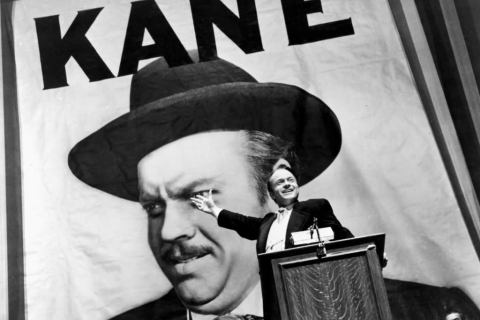
A contemporary introduction of government abomination, a Gatsby-esque tell-tale of self-fulfillment, and a nod at the modern perception of media are all thematically present in Orson Welles' epic Citizen Kane. Welles used cinematic elements to enhance these themes for our viewing pleasure, and the greater good of "good" cinema. This is prevalent when your attention is shifted from the movie's non-chronological, and sometimes hard-to-follow, order of stories to the lighting of the film; when something significant or a motif is introduced, the light source is almost always pointing to or from the object, idea, or theme in mind.


In this scene, our narrator, Thompson, is reading Thatcher's memoir's of his time with a young Kane as his guardian. Here, Kane's mother pleads with him to go with Thatcher, as he has money and will be able to give him a better life than she. The aspect of high key lighting may not be as prevalent as other scenes that use low key lighting, yet the use translates into the viewer paying much attention to this scene. This is Kane's first instance of denial that he will have to face much in his years. Many themes in the film can be traced by to his unloving mother and loss of childhood (isn't that exactly what "rosebud" is?? who knows!!) due to this particular scene. An average movie would use this lighting in order to convey a basic, almost useless scene, but Welles' inclement to break this cinematic norm forces the shift to Kane's lack of acceptance from a young age. 

Right before the prior scene is when the narrator actually finds Thatcher's records and begins to read them. The light source intimidatingly beats down on the book, somewhat symbolizing it's ethereal importance in the film. When Thompson reads the memoirs, he finds Kane's depressed and unfulfilled past, where he experiences denial, neglect, and failure all for the first times in his life. The viewers' attention is put on this book and away from the subjects, who in a film at this time would be the focus of most scenes, to the book in order to hit them with a director's favorite cinematic element- "pay close attention here; this may explain the whole movie!!!!!"


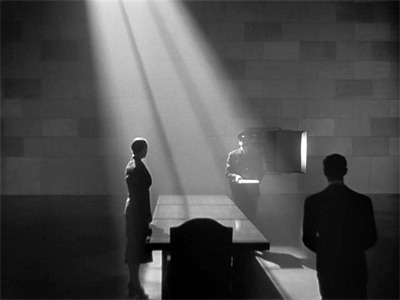
Yet, Welles' (mostly) impeccable use of lighting was not as impeccable in one scene that caught my attention as mostly confusing, given the other thematic uses of lighting. Directly after the first view of Kane, the news reel at the beginning, the reporters talk about Kane's death and how they can make a story out of his infamous last words - "rosebud" - as the light from the projector beats down on them. In other light sources I analyzed in this essay and in viewing the film, when a light source is as prevalent as it is in this scene, it points to a flaw of Kane, like his narcissistic nature or obsession with media-presentation. This scene only brings the attention from the newsreel prior. Does it mean that the only view we will ever know is how the media perceives him? Is this related to Thompson's last words on Kane, where he tells us that we cannot describe a man in a single word we have heard from the media? All could be true, but this theme strays away from the film's primary thematic element of inner-loathing and self-obsessing.

This film is regarded as a breakthrough for creative minds everywhere, as most directors weren't too focused on cinematic elements when they could make the big bucks from relevant actors and large, fancy sets. 22 years later, Italian director Federico Fellini directed and wrote the ground-breaking film 8 1/2, which is known for its eccentric cinematic elements and ideology of self-revelation. In this shot, the low-key lighting highlights the anti-hero's (in photo: on the left, Guido) obsessive fascination for this woman, Claudia, whom is not apparent in much of the film. Guido spends the duration of the film in his own thoughts and memories, existentially questioning his intent for the film he is making. The light source focuses on Claudia - or the apparition he has of Claudia (see: Gatsby-esque allusion in first paragraph). In contrast to Kane, the focus is not subjective as in 8 1/2, but we see the external perception of his peers. Not only do 8 1/2 and Kane use light for aesthetically pleasing and pinnacle shots, the light source accentuates the underlying themes of rejection and narcissism.  


Sunday, September 20, 2015

1935 Create a Movie: "The Night of The Looking Glass"


Imagine: the story of a man, battling the Depression in 1935. He's been laid off from his job as a postman, and he's stuck in the void of other everyday men looking for jobs that aren't there. He is still an honest man, searching to provide for his family of five - a wife and three children, all under the age of 10. In the middle of all of our protangist's dismay, as if this meeting was fate, as impeccably good-looking man shows up on  his doorstep, asking to stay the night in their small house. Our man complies, and they spend the night drinking and telling stories of their youth. The next day, our protagonist's face has turned somewhat odd; he seems older, uglier, and his personality is more smug and off-putting. His family is not able to talk to him about what has happened, but they've placed their blame on the visitor, who has strangely dissappeared before they woke. Madness is in store for this smalltown family as they attempt to solve the mystery of their father's ever-changing face.

The film would express a moralistic theme of family values. The father almost completely leaves his family for this stranger, who metaphorically and physically sucks the youth from him. By expressign this artistically, audiences would walk out of the theatre and express gratitude to their family members, in case a mysterious stranger attempts to steal them away.

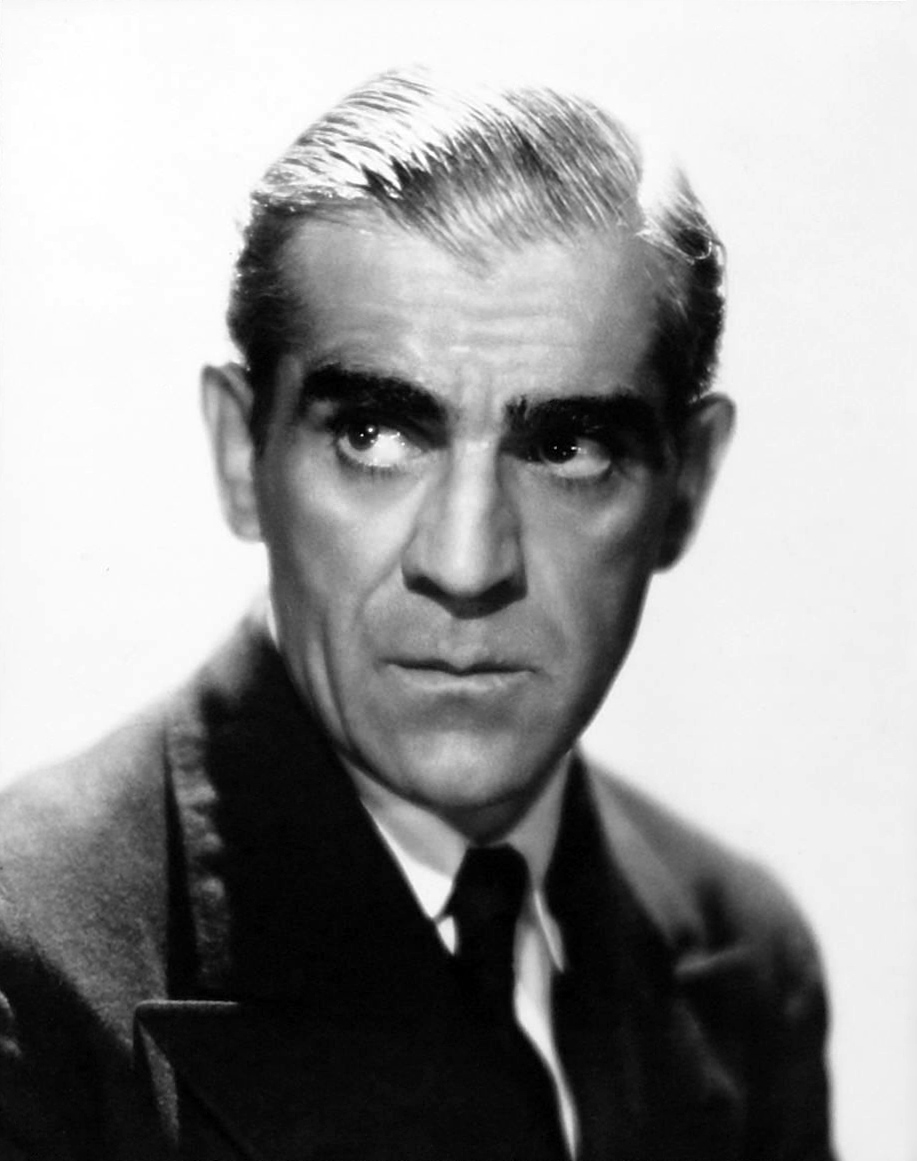
The film fits into the category of mystery/horror, so Universal would be an obvious choice for the studio to engage audiences that expect to be scared. Fan-favorites Boris Karloff and Bela Lugosi star as the family-man and mysterious visitor, respectively. Audiences would recognize those names and flood the theatres, as hoped by Universal. By casting those two, and by the film's dark tones and eerie cinematography, it will easily be a horror film that a small portion of audiences at this time appreciate.

To capture Karloff's transition from man to monster, makeup artist Jack Pierce would be hired for his work with Karloff on Frankenstein and The Mummy. To keep in line with the acclaimed horror film crew, Karl Freund would be hired as the director to ensure a completely unnerving set. The use of a few up-to-date cameras will work well to emphasize the film's grotesque transformation of the main character.

In the Hay's Code, there is no indication on whether or not grotesque characters are allowed in a movie if they are unsettling to the eye. So, Warner Brothers will continue to fund this film as is. The only curveball the Hay's Code may have thrown was the fact that lower standards of life are displayed in the film. After he undergoes the transformation, he is evil and terrible to his family- the script including some abuse and offensive language. To get around this, there will be no airtime of abuse, only slight bruises on his son in some uncomfortable scenes and shots of inaudible yelling while the camera is panned in front of their house, to showcase it could be happening at a house in the neighborhood, no the protagonist's.

For the box office, this film would not do as well as other films, due to its nature. A horror film, even of excellent quality, will hardly outsell a comedy or drama, especially in 1935 when Americans feared abrasive leaders (and another Stock Market Crash). The film has aesthetic appeal and an overall cult film vibe, so it would become a classic to horror fans, as The Wolfman and Creature from the Black Lagoon have become

Sunday, September 13, 2015

MYST #1 "The Usual Suspects" Or "Fare for My Anxiety"

To whom it may concern: I have a lot of feelings (see title) after viewing this movie, particularly towards to acclaimed plot twist at the end, so if you have not seen this movie, and you tend to become very aggressive to spoiler alerts - SPOILER ALERT: Do not read this for your own good. Watch the movie.

To whom it definitely concerns: This Bryan Singer's neo-noir crime thriller starts as your run-of-the-mill heist film - a shot of a bad guy here, some explosion over there, then some text telling the viewer we're now in the present, inferring whatever crime that just happened had, in fact, already happened in this universe. Cut to Kevin Spacey, playing a dumb cripple, Verbal Kint, who's reminded how immensely dumb and crippled he is in just about every scene. Primarily, the viewer's perspective is through Verbal's interragation with special agent Dave Kujan, played by Chazz Palminteri, who demands that diabolical liar, Verbal, tell his story from the beginning.

I won't go on to the whole story, as you've (hopefully) seen this movie before.

Our main "suspects" are rounded up and proceed to take out any New York officers they can; at least, that's what I think they're doing. Roger Ebert wasn't wrong when his review of this film claimed the plot wasn't easy to follow (he actually tore it's incoherentness to shreads). Yet, I was still intrigued to see just who this myth of a man, Keyster Soze, was.

The lighting is used as somewhat of a motif in this film; we see multiple shots of Keaton illuminated, foreshadowing his possible identity as Soze. In the scene where we meet Kobayashi, Soze's right-hand man, Keaton opens a briefcase of files Soze has on each of the suspects, and there is a definite light source coming from the briefcase, lighting Keaton, alluding to the fact that he put together the file and acted terrified of "Soze" to justify to the group "hey dudes this wasn't me don't worry it's not like I'm an ex-cop and have the knowledge to gain this information or anything." The Pulp Fiction-esque maguffin proves to just a simple maguffin to my (and others) dismay.


(I couldn't find a shot of the opening of the briefcase online, so this is the best I could do.)

After some long and intense fight/chase/further interrgation scenes, Kujan antagonizes our favorite cripple with the revelation (yay!) that Keaton is, as we guessed, Soze himself. Verbal cries because him and Keaton were somehow bestest friends, but works up his dignity in a very suspicious way to walk out of the office. Then, Kujan's real (this is actually the end guys!) revelation that the stupid, idiot, provocable cripple is Soze.

At this point, I was whispering "no no no no" while my dad, who has seen the movie, laughs at me loudly. Verbal starts to walk with no limp as I let out a small and high-pitched "ahhhhhhh." Hollywood's classic gimmick of the-only-one-you-could-rely-on-is-actually-a-total-madman-and-you-should-feel-ashamed is so, so evident.

The film is a big scheme you have to devote yourself to. If I didn't completly ruin it for you (I know I did), take three hours out of a day to see it, and hour and 45 minutes to view, and the other hour and 15 minutes to feel your heart palpitate.


FOUR OUT OF FIVE JAME FRANCO'S AS OZ IN "OZ: THE GREAT AND POWERFUL" (2013)